
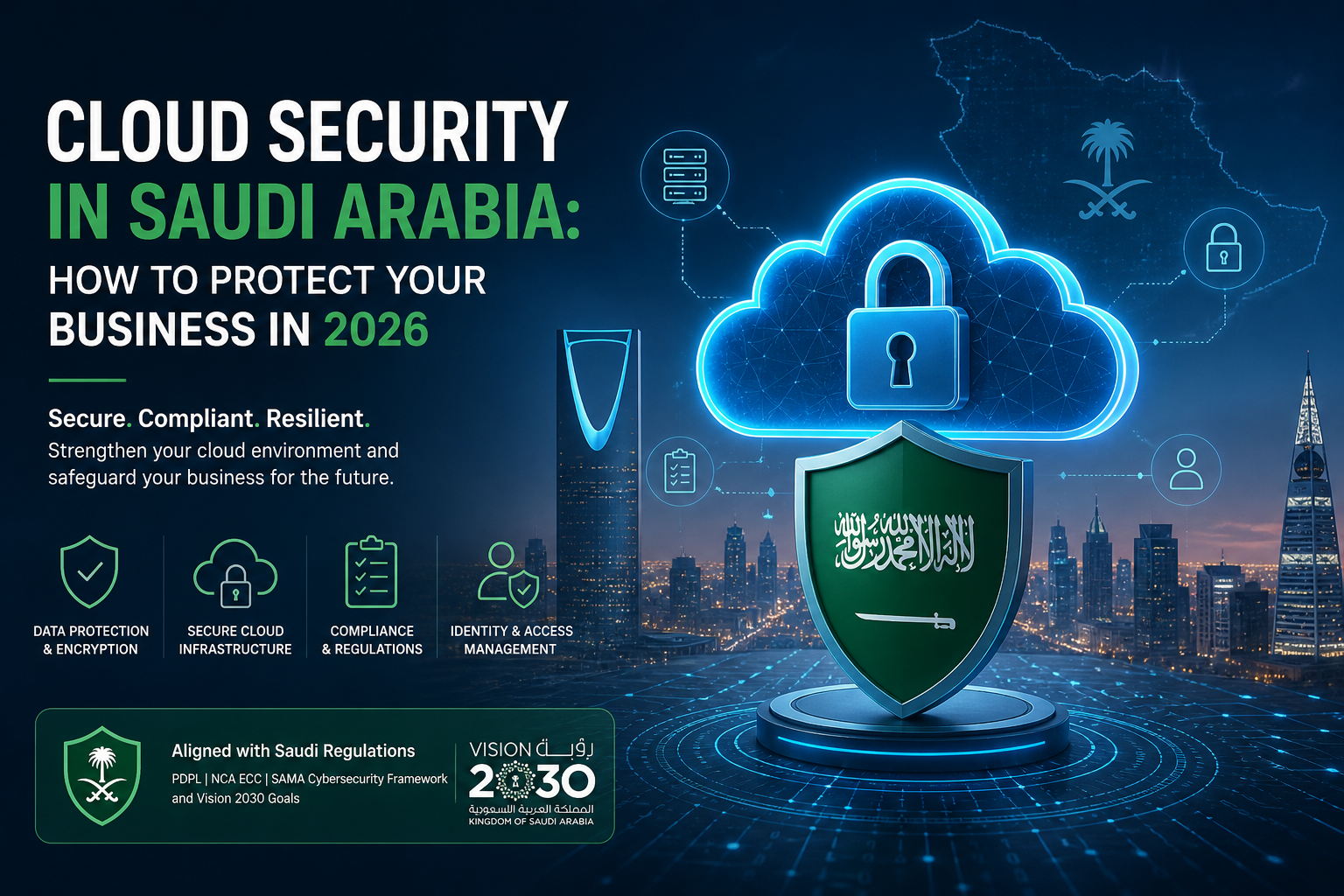
Cloud security Saudi Arabia has never been more critical. Saudi businesses are moving to the cloud faster than ever. Microsoft Azure, AWS, and Google Cloud adoption across the Kingdom has accelerated dramatically, driven by Vision 2030 digital economy goals, remote work normalization, and the undeniable operational advantages cloud infrastructure delivers.
But cloud adoption without a corresponding investment in cloud security is one of the most dangerous mistakes a Saudi business can make in 2026. Every week, organizations across KSA discover that migrating their data and applications to the cloud without proper security controls creates vulnerabilities that on-premises systems never had. The attack surface expands. The regulatory exposure increases. And the cost of a breach — both financial and reputational — can be catastrophic.
At Trackinst, we have helped hundreds of Saudi businesses build cloud environments that are both powerful and genuinely secure. This guide covers everything you need to know about cloud security in Saudi Arabia in 2026: the threats you face, the regulatory requirements you must meet, and the practical steps to protect your business.
Cloud Security Saudi Arabia: The Threat Landscape in 2026
Saudi Arabia has become one of the most targeted countries in the world for cyberattacks. The Kingdom’s rapid economic growth, high-value energy infrastructure, and ambitious digital transformation agenda make it an attractive target for nation-state actors, organized cybercriminal groups, and opportunistic attackers alike.
The shift to cloud has introduced new attack vectors that many Saudi organizations are unprepared for. The most significant threats in 2026 include misconfigured cloud storage — where sensitive business data is accidentally exposed publicly due to incorrect access settings. Compromised credentials remain the leading cause of unauthorized cloud access.
Ransomware attacks targeting cloud environments have increased by over 200% in the GCC region in the past two years, specifically targeting businesses without proper backup and recovery procedures. API vulnerabilities in cloud-connected applications create entry points that bypass traditional perimeter security. And insider threats — whether malicious or accidental — are amplified in cloud environments where data is accessible from anywhere on any device.
Understanding these threats is not meant to discourage cloud adoption. Cloud infrastructure, when properly secured, is actually more secure than most on-premises environments Saudi businesses can build and maintain themselves. The goal is informed adoption — embracing cloud’s benefits while implementing the controls that make those benefits sustainable.
Saudi Arabia’s Cloud Security Regulatory Requirements
Effective cloud security Saudi Arabia practices require compliance with a regulatory framework that is among the most comprehensive in the region. Failing to meet these requirements is not just a legal risk — it is a business risk, as regulatory violations can result in operational restrictions, significant fines, and reputational damage that impacts client relationships and market position.
National Cybersecurity Authority (NCA) Requirements
For cloud security Saudi Arabia compliance, the NCA’s Essential Cybersecurity Controls (ECC) and Cloud Cybersecurity Controls (CCC) establish mandatory security requirements for organizations operating cloud services in the Kingdom. Key requirements include data classification and protection controls, identity and access management standards, incident response and reporting obligations, and supply chain security requirements for cloud service providers. For critical sector organizations — government entities, financial institutions, healthcare providers, and energy companies — compliance with NCA frameworks is non-negotiable.
Data Localization Requirements
Saudi Arabia’s data localization requirements mandate that certain categories of sensitive data must be stored within the Kingdom’s geographic borders. This has significant implications for cloud architecture: not all cloud regions and availability zones meet Saudi data residency requirements. AWS, Microsoft Azure, and Google Cloud all operate data centers in Saudi Arabia specifically to address these requirements. Properly configuring your cloud environment to ensure data residency compliance requires understanding both the technical cloud configuration and the regulatory requirements — a combination that demands specialized expertise.
Personal Data Protection Law (PDPL)
For cloud security Saudi Arabia compliance, Saudi Arabia’s Personal Data Protection Law, enforced by the Saudi Data and Artificial Intelligence Authority (SDAIA), establishes obligations for how organizations collect, process, store, and transfer personal data. Cloud environments that process personal data must implement appropriate technical and organizational controls to ensure PDPL compliance — including data encryption, access controls, breach notification procedures, and data subject rights management.
7 Critical Cloud Security Controls Every Saudi Business Needs
1. Identity and Access Management (IAM)
The most fundamental cloud security Saudi Arabia control is ensuring that only the right people can access the right resources — and that those people are verified rigorously, not assumed based on a username and password alone. Multi-factor authentication (MFA) must be enforced for all cloud accounts without exception. Privileged access management controls must limit who can make administrative changes to your cloud environment. Role-based access control (RBAC) ensures users have only the minimum permissions needed for their job functions. And regular access reviews must identify and revoke permissions for departed employees, contractors, and anyone whose role has changed.
2. Data Encryption
Sensitive business data must be encrypted both in transit and at rest in cloud environments. Encryption in transit means using TLS/HTTPS for all communications between users, applications, and cloud services. Encryption at rest means ensuring stored data is encrypted so that even unauthorized access to the underlying storage does not expose readable information. Organizations handling particularly sensitive data — healthcare records, financial information, legal documents — should consider client-side encryption where encryption keys are managed by the organization rather than the cloud provider.
3. Cloud Security Posture Management (CSPM)
When it comes to cloud security Saudi Arabia, organizations must watch for misconfigurations carefully. Misconfiguration is the leading cause of cloud data breaches globally — and it is entirely preventable. Cloud Security Posture Management tools continuously scan your cloud environment for security misconfigurations: storage buckets with public access, overly permissive security groups, unencrypted databases, and hundreds of other configuration risks. Implementing CSPM gives your security team real-time visibility into your cloud security posture and automated alerts when dangerous configurations are detected.
4. Network Security Controls
For cloud security Saudi Arabia network protection, cloud environments require the same security discipline as on-premises infrastructure — but the implementation is different. Virtual Private Clouds (VPCs), security groups, and network access control lists must be configured to limit traffic flows to only what is necessary. Web Application Firewalls (WAFs) protect cloud-hosted applications from common attack patterns. DDoS protection must be enabled for internet-facing services. And network traffic monitoring must capture the data needed to detect and investigate suspicious activity.
5. Backup and Disaster Recovery for Cloud Security Saudi Arabia
Moving to the cloud does not eliminate the need for backup — it is a key part of any cloud security Saudi Arabia strategy — it changes how backup is implemented. Many organizations mistakenly believe that cloud providers automatically protect their data against loss. In reality, cloud providers protect the infrastructure; you are responsible for protecting your data. Automated backups must be configured, geographically redundant where required, regularly tested for recoverability, and protected against ransomware encryption of backup files. Your Recovery Time Objective (RTO) and Recovery Point Objective (RPO) must be defined and validated through regular disaster recovery testing.
6. Cloud Security Saudi Arabia Monitoring and Incident Response
A robust cloud security Saudi Arabia program requires continuous monitoring and active incident response. You cannot defend against threats you cannot see. Cloud environments generate enormous volumes of security-relevant log data — authentication events, API calls, configuration changes, network traffic — that must be collected, analyzed, and acted upon. Security Information and Event Management (SIEM) systems aggregate and correlate this data to identify potential security incidents. But technology alone is not enough: you need defined incident response procedures, trained personnel, and clear escalation paths for serious security events. Continuous monitoring significantly reduces the time between initial compromise and detection — which is critical, because the longer an attacker is in your environment, the greater the damage.
7. Vendor and Supply Chain Security
Your cloud security Saudi Arabia posture is only as strong as the weakest link in your supply chain. Third-party applications integrated with your cloud environment, SaaS platforms your employees use, and technology vendors with access to your systems all represent potential entry points for attackers. Vendor security assessments, contractual security requirements, and ongoing third-party risk monitoring must be part of your cloud security program — not an afterthought.
Common Cloud Security Mistakes Saudi Businesses Make
Through hundreds of cloud security Saudi Arabia assessments, Trackinst’s security team has seen the same mistakes repeated again and again. The most common mistake is treating cloud migration as a one-time project rather than an ongoing security program. Organizations invest heavily in getting to the cloud securely, then reduce security investment once migration is complete — precisely when ongoing vigilance becomes most critical. Cloud environments change constantly: new services are deployed, configurations drift, users are added and removed, and the threat landscape evolves. Security must be continuous, not episodic.
Another widespread mistake is failing to properly configure multi-factor authentication. Organizations enable MFA for some accounts but not others, or implement it for external access but not administrative accounts, leaving critical gaps. Shadow IT is a growing problem as well: employees sign up for cloud services independently without IT knowledge or security review, storing sensitive business data without appropriate controls. And many Saudi businesses underinvest in security skills and training — relying on generalist IT staff to manage cloud security without appropriate certifications or external support creates gaps that attackers exploit.
How Trackinst Delivers Cloud Security Saudi Arabia Businesses Can Trust
As part of our comprehensive cybersecurity solutions for businesses, Trackinst’s cloud security services are designed specifically for Saudi businesses operating in the Kingdom’s unique regulatory and threat environment. We do not offer generic cloud security templates — we build security programs tailored to your industry, your regulatory obligations, and your specific cloud environment.
Our Cloud Security and Compliance service covers the full spectrum of requirements. We begin with a comprehensive cloud security assessment that identifies your current security posture, regulatory gaps, and priority risks. Our certified engineers then implement the controls your environment needs — IAM configuration, encryption setup, network security architecture, monitoring deployment, and backup configuration — following NCA guidelines and international frameworks including ISO 27001 and CIS Controls.
Our Cybersecurity Solutions team integrates with your cloud environment to provide ongoing threat monitoring, vulnerability management, and incident response. Our Firewall Solutions protect cloud workloads from external threats. Our VPN Solutions secure remote access for employees connecting to cloud resources from any location. And our IT Compliance and Auditing services verify ongoing compliance with NCA requirements, PDPL obligations, and industry-specific regulations.
For Microsoft cloud environments, our Microsoft 365 and Exchange Setup team ensures your Microsoft stack is securely configured, properly licensed, and protected against the most common attack vectors. Our Cloud-to-Cloud Backup Services protect your Microsoft 365 data against accidental deletion, ransomware, and other data loss scenarios that Microsoft’s standard service does not cover. We serve businesses across Riyadh, Jeddah, Dammam, and the broader Kingdom with deep local knowledge that international providers simply cannot replicate.
Building a Cloud Security Roadmap for Your Business
Your cloud security Saudi Arabia roadmap should start with quick wins. Whether you need IT SLA support services or full cloud security, improving your cloud security does not have to mean addressing everything at once. A structured roadmap allows you to prioritize the controls that reduce the most risk first, then build comprehensively over time. In the first 30 days, focus on identity security: enforce MFA across all accounts, review and reduce excessive permissions, and ensure all privileged access is properly controlled. In the following 60 days, focus on visibility: deploy cloud security monitoring and ensure logging is enabled across all critical services. Over the subsequent 90 days, address configuration security, backup integrity, network controls, and regulatory compliance gaps. Beyond the initial 90 days, cloud security becomes a continuous program of monitoring, improvement, and adaptation.
Frequently Asked Questions
Is Cloud Security Saudi Arabia Good Enough for Sensitive Business Data?
Yes — when properly configured and secured, cloud environments from leading providers offer security capabilities that most Saudi businesses cannot replicate with on-premises infrastructure. The critical qualifier is “properly configured.” Cloud security is a shared responsibility: the provider secures the underlying infrastructure, and you secure everything running on it. Businesses that implement appropriate controls consistently achieve stronger security outcomes in the cloud than with on-premises systems.
Do we need to store all our data in Saudi Arabia?
It depends on the type of data. Saudi data localization requirements apply to specific categories — particularly personal data about Saudi citizens and residents, and data in regulated sectors like healthcare and finance. A thorough data classification exercise with legal and regulatory input will identify which data must remain in-Kingdom and which can be processed internationally. Trackinst’s compliance team can help you navigate these requirements for your specific industry and data types.
Can Trackinst help if we have already moved to the cloud without proper security?
Absolutely. Many of our most impactful engagements involve organizations that have already migrated to cloud and need to implement proper security controls. Our cloud security assessment will identify your current gaps, and our team will implement the controls needed to bring your environment to an appropriate security standard. It is never too late to improve cloud security — and delaying is costly.
Take Control of Your Cloud Security Saudi Arabia Today
Effective cloud security Saudi Arabia implementation gives your business the best of both worlds. The cloud offers Saudi businesses transformative capabilities: scalability that grows with your ambitions, cost efficiency that frees budget for growth, collaboration tools that connect teams across cities and time zones, and access to cutting-edge capabilities — AI, analytics, automation — that were previously available only to the largest enterprises.
Investing in proper cloud security Saudi Arabia protects all of these gains. None of these benefits are worth the risk of an unsecured cloud environment. A single breach can erase years of operational gains, destroy client trust built over decades, and create regulatory liability that threatens the business itself. Trackinst’s cloud security services give you both: the full benefits of cloud adoption and the confidence that your data, your operations, and your reputation are protected.
Contact Trackinst today for a free cloud security Saudi Arabia assessment. Our team will review your current cloud environment, identify your key risks, and provide a clear roadmap for achieving the security posture your business deserves.
📞 Call or WhatsApp: +966 59 771 6771
📧 Email: info@trackinst.com.sa
📍 Office #6, Mather Complex, Al Olaya, Building 24, Riyadh 12554
🌐 trackinst.com.sa